
An examination of the global artificial botanical market in 2026 reveals a significant terminological and material divergence that poses a challenge for B2B importers. The term "silk flower" has evolved from its historical origins to primarily denote high-grade polyester fabrications, creating a potential for misunderstanding in sourcing. This guide provides a comprehensive analysis comparing modern polyester-based silk flowers with polyurethane (PU) "real touch" alternatives. It investigates the material science, manufacturing processes, and tactile properties that define each category. Furthermore, the analysis extends to the strategic sourcing landscape, focusing on China's key manufacturing hubs—Guangdong, Tianjin, Zhejiang, and Xiamen—and their respective specializations. By evaluating factors such as durability, lifecycle cost, and application-specific suitability, this document equips procurement managers and business buyers with the nuanced understanding required to make informed purchasing decisions. The objective is to bridge the information gap, enabling importers to align their product selection with specific market demands for realism, longevity, and return on investment.
The journey into the world of artificial botanicals begins with a fundamental act of clarification. The very term "silk flower" is, in the contemporary market of 2026, a profound misnomer, a ghost of a past when genuine silk threads were painstakingly woven to replicate petals. To grasp the realities of sourcing today, one must look past this romantic nomenclature and into the world of advanced polymers and sophisticated manufacturing. What we now call a silk flower is a product of material science, a testament to how synthetic fibers can be engineered to capture the delicate essence of nature. A failure to understand this distinction is not merely a semantic error; it is a potential sourcing misstep, one that can impact everything from product quality to profit margins. The professional buyer must become a student of materials, learning to discern the subtle yet significant differences that define quality in this industry.
Think for a moment about the expectations the word "silk" conjures: luxury, softness, a certain organic sheen. Manufacturers leverage this association, but the material itself is almost always a high-grade polyester or a blend of similar synthetic fabrics. This is not an act of deception but rather an evolution of industry language. The goal is no longer to use a specific natural fiber but to achieve a specific aesthetic and functional outcome—a lifelike appearance combined with durability. Our task, then, is to peel back the layers of this term and examine the substance within. What kind of polyester are we talking about? How is it transformed from a simple thread into a convincing petal? Understanding this process is the first step toward becoming a discerning and strategic importer.
The story of the silk flower begins, as the name suggests, with actual silk. Centuries ago, artisans in China, and later in Italy and France, used the luxurious fabric to create floral replicas for the wealthy. These were true works of art, fragile and expensive, each petal cut and shaped by hand. They were status symbols, adorning the homes and clothing of the elite who could afford such delicate, handcrafted beauty. The very essence of these early creations was tied to the preciousness of their core material. The shimmer and soft texture of real silk gave these flowers a lifelike quality that no other material at the time could match.
However, the industrial revolution and the subsequent development of synthetic fibers in the 20th century changed everything. The invention of rayon, then nylon, and finally polyester opened up new possibilities. These materials were far cheaper to produce, more durable, and could be manipulated with greater ease and consistency than natural silk. The term "silk flower," however, had already lodged itself in the public consciousness. It had become a generic descriptor for any high-quality artificial flower, a synonym for "fake flower" that carried connotations of elegance rather than cheapness.
As manufacturing shifted from Europe to Asia, and as technology advanced, polyester became the undisputed king. Its ability to hold dyes, retain its shape when heated, and resist wrinkling made it the ideal candidate for mass production. So, when you encounter the term "silk flower" today from a supplier, it is an inherited industry shorthand. It does not refer to the silkworm's thread but to a category of fabric-based artificial flowers, positioned at a higher quality tier than simple plastic or foam. The legacy of the name speaks to the aspiration of the product—to be as beautiful as those original silk creations—even if the material reality is entirely different. For an importer, this historical context is vital; it allows you to understand why the language is what it is and to focus your inquiries on the actual material specifications, not the romantic label.
Not all polyester is created equal. Just as one would differentiate between types of wood or grades of leather, a sophisticated buyer must learn to differentiate between grades of polyester in the context of a silk flower. The quality of the final product is directly dependent on the quality of its foundational fabric. Suppliers often use terms like "high-grade polyester," but what does that mean in tangible terms? It relates to the fineness of the threads, the density of the weave, and the finishing processes applied to the fabric.
Imagine two scarves. One is coarse and stiff, the other is soft and flows like water. Both could be 100% polyester, but the difference lies in the micro-details of their construction. The same principle applies to the fabric used for a silk flower. Lower-grade polyester might be thicker, with a looser weave, resulting in petals that feel coarse and look opaque. They may not hold their shape as well and can fray at the edges. These are typically used for budget-friendly floral arrangements where durability is prioritized over nuanced realism.
In contrast, the premium fabrics used for a high-quality silk flower are a different matter entirely. These are often microfibers with a very high thread count, making the fabric incredibly soft, lightweight, and slightly translucent, mimicking the delicate nature of a real petal. The weave is tight and secure, preventing fraying and allowing for very precise, clean cuts. Furthermore, these superior fabrics undergo special finishing treatments. They might be coated with a subtle sizing agent to give them a bit more body and a waxy feel, or they might be embossed with a faint texture to replicate the veining of a leaf or petal. When you discuss specifications with a manufacturer, asking about the fabric's denier (a measure of thread thickness) or treatments can provide a much clearer picture of quality than the generic "silk flower" label ever could.
The transformation of a bolt of polyester fabric into a lifelike silk flower is a multi-stage process that blends industrial efficiency with artisanal craftsmanship. It is a dance between machine and human hand.
Fabric Treatment and Cutting: The process begins with large rolls of white polyester fabric. This fabric is first treated with stiffening agents, like starch or a light gelatinous coating. This step is what gives the petal the ability to be shaped and hold a three-dimensional form. Without it, the fabric would be limp. Once treated, stacks of the fabric are placed into a press with cutting dies shaped like petals, leaves, or other floral components. The press cuts hundreds of identical shapes at once, ensuring uniformity.
Dyeing and Printing: The white cutouts are then dyed. For solid-colored flowers, this might involve dip-dyeing the petals in vats of color. For more complex, multi-toned flowers like a rose with a darker edge, the process is more intricate. Color may be applied by hand with airbrushes or through a screen-printing or heat-transfer printing process that applies detailed patterns and gradients. This is where artistry truly comes into play; the subtle blending of colors is what separates a realistic silk flower from a cheap imitation. Some high-end production even involves printing vein patterns directly onto the leaves and petals.
Embossing and Shaping: After dyeing, the flat petals must be given their lifelike curves and textures. This is done through a process called embossing or molding. Each individual petal is placed in a heated mold that has the inverse texture of a real petal, complete with veins and natural ripples. The heat and pressure permanently shape the polyester, giving it a three-dimensional form.
Assembly: This final stage is almost always done by hand. Skilled workers take the individual components—the molded petals, the leaves, the plastic stamen and pistil, and the wire-core plastic stem—and assemble them. Petals are layered and glued in a precise order around the center of the flower. Leaves are attached to the stem. The entire process, from the selection of the fabric to the final arrangement of petals, is a chain of decisions that all contribute to the quality of the final silk flower. Understanding these steps gives a buyer the vocabulary to ask targeted questions about a supplier's capabilities.
Given the material reality, why has the "silk flower" label endured so tenaciously? The reasons are a mix of marketing psychology, industry tradition, and a lack of a better alternative.
From a marketing perspective, the word "silk" is an anchor to quality. It elevates the product above its more rudimentary cousins, the "plastic flower" or "foam flower." It taps into a deep-seated cultural appreciation for silk as a premium material. For a consumer browsing in a store or an event planner selecting decor, "silk flower" immediately communicates a higher standard of beauty and craftsmanship, even if they subconsciously know it is not literal silk. It is a powerful piece of branding that the industry has little incentive to change.
Industry tradition also plays a massive role. For decades, manufacturers, exporters, importers, and retailers have all used this shared language. Catalogs, trade shows, and online marketplaces are organized around this term. To suddenly pivot to a more technically accurate term like "polyester flower" would be disruptive and, frankly, less appealing. "Polyester" is a functional word, not an evocative one. It speaks of chemistry labs and leisure suits, not of botanical beauty. The term silk flower has become a convenient and universally understood shorthand within the trade.
Finally, there is no elegant, universally accepted alternative. While terms like "fabric flower" or "art flower" exist, they have not gained the same traction. "Silk flower" has become the de facto brand name for the entire category of fabric-based artificial florals. For the B2B buyer, the lesson is not to fight the terminology but to see through it. Accept the label as an industry quirk, but base your purchasing decisions on the tangible specifications that lie beneath: the fabric grade, the dyeing technique, the quality of the molding, and the skill of the final assembly. These are the true indicators of the quality of any silk flower.
While the modern silk flower perfects the visual replication of nature, a different category of artificial botanical has emerged to conquer a different sense: touch. Enter the world of polyurethane, or PU, flowers. These are often marketed under the evocative name "real touch" flowers, and for once, the marketing name is remarkably accurate. To handle a high-quality PU flower is a genuinely surprising experience. The petals feel soft, supple, and slightly cool and waxy, mimicking the texture of a living flower to an uncanny degree. This is not just a visual illusion; it is a tactile one.
This development represents a significant shift in the high-end artificial flower market. It moves the goalposts from simply looking real from a distance to feeling real up close. For applications where the audience will have an intimate interaction with the product—a centerpiece on a dining table, a bouquet held by a bride, a display in a luxury hotel lobby—this tactile realism is a game-changer. It elevates the artificial flower from a mere replica to a true sensory substitute. Understanding the science and application of PU is therefore indispensable for any buyer looking to source products for the premium segment of the market. It is a different technology, a different material, and it serves a different, though sometimes overlapping, purpose than the traditional silk flower.
Polyurethane is a remarkably versatile polymer. You encounter it every day in countless forms: as the foam in your furniture, the wheels on a skateboard, the insulation in your walls, or the spandex in your clothing. It is a plastic material that exists in a wide variety of states, from rigid and hard to soft and elastic. It is this chameleon-like quality that makes it so perfect for creating artificial flowers.
Specifically, for "real touch" flowers, manufacturers use a type of thermoplastic polyurethane. In its raw form, it can be a liquid or a flexible solid that can be melted and injected into molds. Unlike the woven fabric of a silk flower, a PU petal is a solid, albeit very thin and flexible, sheet of polymer. The magic happens at a molecular level. The structure of polyurethane can be engineered to have a specific density and flexibility. By carefully controlling the chemical formulation, manufacturers can create a material that has the same weight, suppleness, and even the subtle, fleshy resistance of a real flower petal.
When you press a PU petal between your fingers, you are not feeling woven fibers; you are feeling a solid polymer designed to deform and respond just like living plant tissue. This is why it can replicate the thick, waxy feel of a magnolia, the delicate smoothness of an Artificial Lily, or the slightly rubbery texture of a tulip. It excels in replication because it is not mimicking texture through weaving and coating; it is the texture, created from the ground up at a chemical level.
The "real touch" sensation is not just a happy accident of using polyurethane; it is the result of a deliberate and sophisticated manufacturing process. It combines the inherent properties of the PU material with advanced molding techniques.
The process typically begins with a liquid PU mixture. This liquid is colored with pigments to achieve the base tone of the petal. This is a key difference from a silk flower, where color is applied to a white fabric. In a PU flower, the color is integral to the material itself, which contributes to its realistic translucency and depth. This colored liquid is then injected into or poured over a meticulously crafted mold.
These molds are the heart of the "real touch" process. They are often created from impressions taken from actual, living flowers. Every vein, every tiny imperfection, every subtle curve of the real petal is captured in the mold. When the liquid PU fills this mold and cures (hardens), it picks up every single one of these microscopic details. The result is a petal that does not just have a printed-on vein pattern; it has a physically embossed, three-dimensional vein structure that you can see and feel.
Furthermore, the thermal properties of PU contribute to the effect. The material has a certain coolness to the touch, similar to the coolness of a water-filled petal. Some manufacturers even apply a very fine, invisible coating after the petal is demolded to enhance this waxy or dewy sensation. When you combine the intrinsic flexibility of the polymer, the microscopically detailed mold, and the integral coloration, you achieve a multi-sensory illusion that is incredibly difficult to distinguish from the real thing without close inspection.
To fully appreciate the unique position of PU flowers, it helps to compare them to the other non-fabric materials used in the industry.
| Feature | Polyurethane (PU) | Latex-Coated | Foam (EVA) | Standard Plastic (PVC/PE) |
|---|---|---|---|---|
| Realism | Highest; mimics texture, weight, and suppleness. | High; good tactile feel but can look rubbery. | Medium; lightweight, good for shaping, less realism. | Low to Medium; often looks and feels artificial. |
| Tactile Feel | Soft, waxy, cool, "real touch." | Soft, slightly rubbery. | Spongy, very lightweight. | Hard, smooth, or waxy, clearly synthetic. |
| Durability | Very high; waterproof, crush-resistant. | High; waterproof but can degrade in sunlight. | Medium; can be dented or torn, not waterproof. | Very high; extremely durable, best for outdoor. |
| Price Point | Highest | High | Low to Medium | Lowest |
| Best Use Case | Luxury decor, bridal bouquets, high-end retail. | Premium arrangements, where water resistance is key. | Crafts, budget arrangements, lightweight wreaths. | Outdoor displays, large-scale budget installations. |
Latex Flowers: Sometimes confused with PU, latex flowers are often fabric petals (like a silk flower) that have been coated in a layer of latex. This gives them a "real touch" feel, but the underlying fabric structure can sometimes be detected. True PU flowers are solid polymer. Latex can also be more prone to yellowing over time with UV exposure compared to high-quality PU.
Foam Flowers: Typically made from ethylene-vinyl acetate (EVA) foam, these flowers are extremely lightweight and easy to shape. They are popular in the craft market and for items like floating floral displays. However, they lack the fine detail and realistic weight of PU. The texture is distinctly spongy and porous, and they are easily damaged by pressure or moisture.
Plastic Flowers: This is the broadest and most varied category. At the low end, you have simple injection-molded polyethylene (PE) or polyvinyl chloride (PVC) flowers that look and feel very artificial. They are, however, extremely durable and weather-resistant, making them suitable for outdoor use. At the higher end, new molding techniques can produce more detailed plastic flowers, but they generally lack the soft, supple texture that defines the PU category.
In this context, PU flowers, such as those from leading suppliers of PU artificial flowers, occupy the apex of realism. They are an investment in verisimilitude, chosen when the illusion of life must be as convincing as possible.
Consider the specific cases of the Artificial Lily and the Artificial Lavender. These two flowers perfectly illustrate the market advantages of PU.
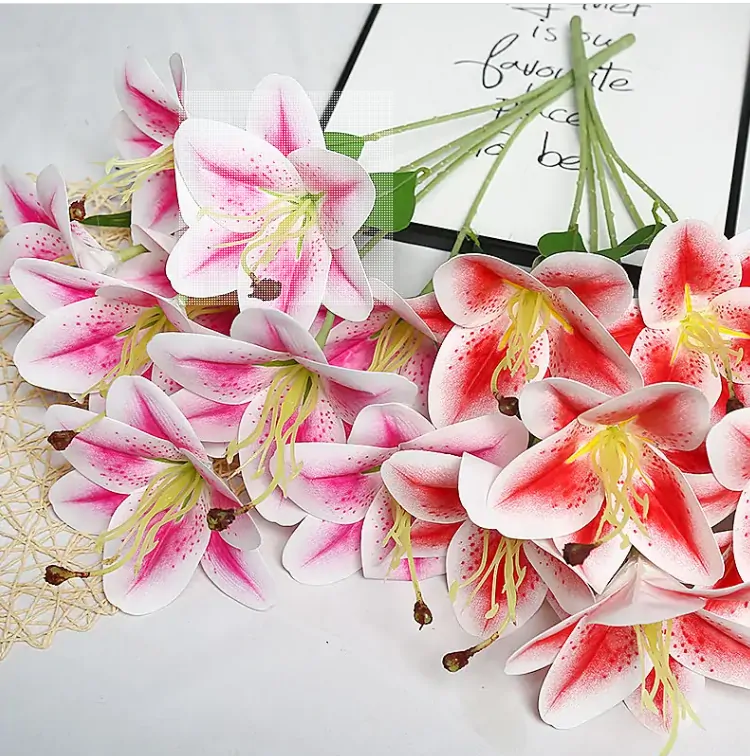
The lily, with its thick, waxy, and almost succulent petals, is a flower that is very difficult to replicate convincingly with fabric. A silk flower lily can capture the shape and color, but the texture will always feel thin and dry in comparison to the real thing. A PU Artificial Lily, on the other hand, is a triumph of material science. The PU material can be formulated to have the exact weight and fleshy density of a real lily petal. The molds can impart the subtle central rib and gentle curve. The result is a product that, when placed in a vase, could fool not just the eye, but the hand as well. For luxury hotel lobbies or high-end home staging, where a bouquet of lilies signifies elegance, the PU version offers unparalleled realism and zero maintenance.
The case of Artificial Lavender is different but equally compelling. A real lavender sprig is composed of dozens of tiny, individual florets. Creating this with fabric is incredibly labor-intensive and often results in a fluffy, indistinct shape. A simple plastic version might capture the shape but will look harsh and artificial. PU provides an ideal middle ground. The tiny buds can be molded with precision from PU, giving them a soft, slightly rubbery texture that is very similar to the real buds. The stems can be made from PE with a flocked coating to mimic the fuzzy texture of the real plant. A sprig of PU Artificial Lavender, therefore, feels more substantial and looks more botanically accurate than its silk flower counterpart. It is perfect for use in smaller arrangements, wreaths, and displays where people might see it up close or touch it. These examples show that the choice of PU is not arbitrary; it is a strategic decision made when the specific biology of the flower being replicated lends itself to the unique properties of the polyurethane polymer.
Once a buyer has a firm grasp of the material differences between a silk flower and a PU flower, the next logical step is to answer the question: where do these products actually come from? For the vast majority of the world's artificial flowers, the answer is China. However, to say "source from China" is about as helpful as saying "buy groceries at the supermarket." It is a vast, diverse, and highly specialized manufacturing landscape. Sourcing successfully requires a more granular understanding of the country's key industrial clusters.
China's dominance in this sector is not accidental. It is the result of decades of developing integrated supply chains, skilled labor forces, and massive economies of scale (Alibaba.com, 2026a). Different regions have cultivated different strengths. Some are masters of high-volume, low-cost production, while others have become centers of excellence for high-end, artisanal quality. Choosing the right sourcing region is as important as choosing the right material. Aligning your product needs with a region's specialty can be the difference between a successful, scalable partnership and a frustrating series of quality control issues. The informed importer does not just look for a supplier; they look for a supplier in the right ecosystem.
While artificial flowers are produced in many parts of China, four regions stand out as the primary hubs for international sourcing, each with its own distinct character and set of advantages. These are Guangdong province (particularly the cities of Guangzhou, Dongguan, and Shenzhen), Tianjin in the north, Zhejiang province (dominated by the city of Yiwu), and the coastal city of Xiamen in Fujian province.
Think of these regions as different departments in a massive floral superstore.
A buyer seeking millions of budget-friendly stems for a mass-market retail chain would have a very different sourcing journey than a buyer procuring exclusive, hyper-realistic botanicals for a chain of five-star hotels. Understanding the profile of each region, as detailed by industry analysts like TrustFloral (2025), is the foundational step in that journey.
Guangdong Province: Located in the Pearl River Delta, Guangdong is one of China's original manufacturing powerhouses. Its proximity to Hong Kong made it an early gateway for international trade. Cities like Guangzhou and Dongguan have a long history of producing artificial flowers. Their strength lies in a mature ecosystem of suppliers for every component part, from fabrics and plastics to wires and dyes. This allows for a high degree of production efficiency. More recently, as noted in market guides (Alibaba.com, 2026b), the region, especially Shenzhen, has become a leader in integrating technology into decorative products. This is where you might find suppliers who can incorporate LED lighting into floral arrangements or create other tech-enhanced decorative items. For a buyer looking for reliable, mid-to-high range quality with the potential for innovative features, Guangdong is a primary destination.
Tianjin: Situated in Northern China, Tianjin's primary advantage is its status as a major port city with world-class logistics infrastructure. This makes it an incredibly efficient point of origin for shipping to Europe and the East Coast of the United States. Suppliers in Tianjin, such as Tianjin Dongchen Crafts, are known for their focus on craftsmanship and export readiness (Alibaba.com, 2026b). They have deep experience in meeting international quality standards and navigating the complexities of global shipping. While perhaps not as focused on the absolute highest end as Xiamen, Tianjin is a bastion of reliable quality and professional export management. For a buyer who prioritizes smooth logistics, consistent quality, and on-time delivery for large orders, Tianjin presents a compelling strategic choice. It is a region built for the business of exporting.
No discussion of sourcing from China is complete without mentioning Yiwu. This city in Zhejiang province is not just a manufacturing center; it is a global phenomenon. The Yiwu International Trade Mart is the largest wholesale market in the world, a sprawling complex where tens of thousands of suppliers display their wares. The section for artificial flowers is vast, offering an overwhelming panorama of every conceivable type, quality level, and price point of silk flower and other artificial plants .
Yiwu's strength is its sheer breadth of choice and its agility. It is the ideal place for buyers looking to source a wide variety of different products from multiple suppliers in one trip. The market is geared towards smaller wholesale orders (though large orders are also handled), making it accessible for small and medium-sized businesses. Furthermore, Yiwu is a hub for Original Equipment Manufacturer (OEM) and Original Design Manufacturer (ODM) services. Suppliers here are accustomed to working with international clients to create custom products based on their specifications or to modify existing designs. If your business model relies on unique, custom-designed floral products or a very wide product catalog, Yiwu is an indispensable sourcing destination. It is a place of endless possibility, but it also requires a discerning eye to navigate the vast differences in quality from one booth to the next.
For the buyer for whom quality is the paramount concern, the journey often leads to Xiamen. This coastal city in Fujian province has carved out a niche for itself at the absolute peak of the artificial flower market. While other regions may compete on price or volume, Xiamen competes on artistry. This is the heartland of the "real touch" PU flower and the most exquisitely crafted, high-end silk flower.
According to a B2B sourcing guide from TrustFloral (2025), manufacturers in Xiamen are distinguished by their focus on refined craftsmanship, the use of premium and consistent materials, and an obsessive attention to aesthetic detail. They are not just manufacturers; they are artisans working with modern materials. Sourcing from Xiamen is typically more expensive, but the price reflects a tangible difference in product quality. The coloration is more nuanced, the molding is more precise, and the final assembly is more lifelike. These are the suppliers that serve luxury brands, high-end interior designers, and premium event planners. They are less focused on mass production and more on partnership with buyers who appreciate and can market a superior product. If you are looking to source the kind of artificial flower that can be mistaken for real, Xiamen is the place to begin your search.
The following table summarizes the key strengths of these regions, providing a strategic map for your sourcing efforts.
| Sourcing Region | Primary Strength | Product Focus | Price Level | Ideal Buyer Profile |
|---|---|---|---|---|
| Guangdong | Mature ecosystem, tech integration | Mid-to-high range quality, innovative designs | Medium to High | Buyers seeking reliable quality and tech-enhanced products. |
| Tianjin | Export logistics, craftsmanship | Mid-range quality, large volume orders | Medium | Buyers prioritizing efficient shipping and consistent quality. |
| Zhejiang (Yiwu) | Unmatched variety, OEM/ODM flexibility | Low to high range, vast selection, custom orders | Low to High | Buyers needing a wide product mix or custom designs. |
| Xiamen | Artisanal quality, material excellence | Premium, high-end, "real touch" PU flowers | Highest | Buyers for luxury markets where realism is paramount. |
Strategic sourcing is not just about finding a factory; it is about building a partnership. This is particularly true when dealing with the more specialized manufacturers in regions like Xiamen or when engaging in complex ODM projects in Yiwu. A transactional, price-focused approach might work for simple, off-the-shelf commodities, but for products where quality and design are key differentiators, a deeper relationship is needed.
Think of your supplier as an extension of your own business. A good partner will understand your market, provide insights into new trends, and work collaboratively to solve problems. This requires open communication, clear expectations, and mutual trust. When evaluating potential suppliers, look beyond the price list. Inquire about their quality control processes. Ask about their material sourcing—do they have stable relationships with their own fabric or polymer suppliers? This is a key indicator of consistent quality (TrustFloral, 2025).
Visit the factory if possible. Seeing the operation firsthand provides insights that no email or video call can. It allows you to assess the working conditions, the organization of the production line, and the skill of the workers. Building this kind of rapport can lead to better pricing in the long run, priority in production scheduling, and a willingness from the supplier to invest in developing exclusive products for you. In the competitive global marketplace, a strong supplier relationship, facilitated by a one-stop foreign trade platform, can become one of your most significant competitive advantages. It transforms sourcing from a simple cost center into a source of innovation and value.
A B2B buyer is not just purchasing a product; they are making an investment in inventory. The return on that investment depends not only on the initial purchase price and the final sale price but also on the entire lifecycle of the product. How long will it look good on a retail shelf? How will it perform for the end-user over time? A flower that fades, breaks, or collects dust in a way that is impossible to clean represents a poor return, both for the importer and the final customer. Therefore, a rigorous analysis of durability and maintenance is not an afterthought; it is a core component of a professional purchasing strategy.
The choice between a polyester silk flower and a PU "real touch" flower is a classic case study in this kind of lifecycle analysis. Their material differences lead to distinct performance characteristics when exposed to real-world conditions. One is not universally "better" than the other; rather, they are suited for different environments and levels of interaction. An importer must consider the probable end-use of their products and select the material that offers the best long-term value proposition for that specific application. This requires moving beyond the initial aesthetic appeal and thinking like an engineer, considering factors like UV radiation, humidity, and the practicalities of long-term care.
The environment in which an artificial flower is placed is its greatest adversary. Sunlight, moisture, and extreme temperatures can all degrade materials over time, causing colors to fade and structures to weaken.
UV Resistance: The ultraviolet radiation in sunlight is the primary culprit behind fading colors. It works by breaking down the chemical bonds in dyes. Here, the quality of the raw materials and the manufacturing process is paramount. For a silk flower, the quality of the dye and whether any UV-inhibiting coatings were applied during production is key. High-quality dyes used on premium polyester are more stable and will resist fading for much longer than cheap dyes on low-grade fabric. PU flowers face a similar challenge. Lower-quality PU formulations can yellow or become brittle with prolonged, direct sun exposure. However, premium PU, like that found from high-end Xiamen suppliers, is often blended with UV stabilizers that significantly prolong its colorfastness and flexibility. For any flower intended for a sunny room or a covered outdoor space, asking a supplier for data on UV resistance is a wise move.
Humidity and Moisture: This is where a major divergence between silk and PU appears. A polyester silk flower is, at its core, a fabric product. While some coatings may offer a degree of water resistance, prolonged exposure to high humidity or direct contact with water can be problematic. The fabric can absorb moisture, causing it to sag or lose its shape. The glues used in assembly can weaken. In a damp environment, there is even a risk of mildew forming on the fabric over time.
PU flowers, being a solid, non-porous polymer, are completely waterproof. An Artificial Lily made of PU can be rinsed under a tap without any ill effects. This makes them an outstanding choice for bathrooms, spa environments, covered patios, or any location where humidity is a concern. This inherent water resistance is one of the most significant functional advantages of PU over any fabric-based flower.
Temperature: Extreme heat can soften the plastics used in stems and can, in some cases, affect the shape of molded petals. Extreme cold can make some plastics more brittle. In general, both high-quality silk flowers and PU flowers are stable within the normal range of indoor temperatures. However, for applications in locations with dramatic temperature swings (e.g., a conservatory), it is worth confirming the material specifications of the stems and other plastic components to ensure they are made from a stable polymer like PE or ABS rather than a less resilient plastic.
The long-term beauty of an artificial flower depends on its ability to be cleaned. Dust is the inevitable enemy of all interior decor. The ease and effectiveness of cleaning are major factors in end-user satisfaction.
Cleaning a Silk Flower: The porous nature of the fabric makes cleaning a silk flower more delicate.
Cleaning a PU Flower: The non-porous surface of PU makes cleaning dramatically simpler and more effective.
For a B2B buyer, this difference is a key selling point. For hospitality clients, the ability to quickly and thoroughly clean floral arrangements is a major labor-saving benefit. For retailers, being able to advise customers that their premium PU flower can be washed like a piece of dishware is a powerful argument for its higher price point.
The initial procurement cost is only one part of the financial equation. The true cost of ownership must account for the product's effective lifespan. A cheap silk flower that fades in six months and must be replaced is ultimately more expensive than a premium PU flower that looks pristine for years.
Imagine two scenarios for a hotel lobby centerpiece:
In Scenario B, despite the higher initial outlay, the true cost of ownership is significantly lower. The hotel has avoided the cost of replacement products and the labor involved in re-sourcing and re-installing them.
When sourcing, a buyer should think in these terms. Ask suppliers for information on the expected lifespan of their products under specific conditions. While guarantees may be rare, a reputable manufacturer will be able to speak to the quality of their dyes and UV stabilizers and provide a realistic expectation of performance. This allows the buyer to calculate a more accurate long-term value and to better communicate that value to their own customers. The longevity of a high-quality artificial flower, whether silk or PU, is its core economic advantage over fresh flowers, and maximizing that longevity is key to a successful business model.
In 2026, no discussion of manufacturing is complete without addressing sustainability. The artificial flower industry, rooted in plastics and polymers, faces valid questions about its environmental impact. For a B2B buyer, understanding these issues is becoming increasingly important, both for corporate social responsibility and because a growing segment of consumers is making purchasing decisions based on environmental ethics.
The primary materials—polyester (a silk flower) and polyurethane (a PU flower)—are derived from petroleum, a non-renewable resource. They are not biodegradable. This is the core environmental challenge of the industry. However, the sustainability argument for artificial flowers rests on a different premise: longevity and waste reduction.
Consider the fresh flower industry. It involves intensive agriculture, often with significant water and pesticide use. The flowers are then transported in refrigerated containers across the globe, consuming enormous amounts of energy. And after a week or two, they are thrown away, contributing to organic waste. This cycle repeats endlessly.
An artificial flower, by contrast, is a "buy it once" product. A single high-quality arrangement can prevent dozens, or even hundreds, of fresh bouquets from being grown, shipped, and discarded over its lifespan. The environmental impact is front-loaded into its manufacturing. Therefore, the most sustainable artificial flower is the one that lasts the longest. This brings us back to durability. A cheaply made flower that is quickly discarded is an environmental negative. A durable, high-quality PU or silk flower that is used for a decade represents a significant reduction in waste and resource consumption compared to the alternative.
Forward-thinking manufacturers are also beginning to explore more sustainable options. This includes using recycled polyester (rPET) for silk flower fabrics, investigating bio-based polyurethanes derived from plant oils, and designing products for easier disassembly and recycling of their component parts (e.g., separating the polymer petals from the metal wire stems). As a buyer, inquiring about a supplier's efforts in these areas can not only align your business with modern ethical standards but also uncover new marketing angles for your products.
The technical and logistical considerations of sourcing are all in service of a final goal: placing the right object in the right setting. The choice between a polyester silk flower and a PU "real touch" flower is not an abstract exercise; it is a practical decision driven by the intended application. The aesthetic requirements of a wedding bouquet are different from those of a commercial office planter, which are different again from a luxury retail display. A successful importer is a matchmaker, pairing the unique qualities of each type of flower with the specific demands of the environment it will inhabit.
The aesthetic dimension of this choice is subtle but profound. It involves thinking about how the flower will be perceived. Will it be seen from a distance or viewed up close? Will it be touched? What kind of light will it be under? What is the overall design language of the space it will occupy? A high-grade silk flower offers a softness and a certain "flow" that can be ideal for large, romantic arrangements. A PU flower offers a crisp, sculptural, and hyper-realistic quality that excels in modern, minimalist settings. The art of selection lies in understanding these nuances and anticipating the sensory experience of the end-user.
In the world of luxury hotels, upscale restaurants, and high-end retail boutiques, the details are everything. The environment is meticulously curated to create an atmosphere of quality and exclusivity. In these settings, where clients are in close proximity to the decor and have high expectations, the argument for PU flowers is exceptionally strong.
Consider a boutique hotel lobby. The floral arrangement on the reception desk is not just background decoration; it is a statement piece. It is one of the first things a guest sees, and it sets the tone for their entire experience. A guest might lean on the counter, inches from the flowers, while checking in. In this scenario, the tactile realism of PU is invaluable. An artificial lily that looks and feels indistinguishable from the real thing projects an image of quality and attention to detail, without the daily cost and maintenance of fresh flowers. The fact that PU flowers are waterproof and easy to clean is also a massive operational advantage for housekeeping staff, who can keep the arrangements looking perfect with a simple wipe-down.
Similarly, in a luxury retail environment, such as a jewelry store or a high-fashion boutique, PU flowers can enhance the perceived value of the products on display. A display of PU orchids or calla lilies next to a collection of watches adds a touch of organic elegance that feels authentic and luxurious. Because the flowers will not wilt, shed pollen, or require water, they pose no risk to the valuable merchandise. For these premium applications, the higher initial investment in PU flowers is easily justified by the superior aesthetic performance and long-term ease of care.
The events industry, particularly the wedding market, has different priorities. While realism is important, so are factors like volume, cost-effectiveness, and the ability to create large, dramatic installations. This is where the high-grade silk flower truly shines.
Imagine constructing a massive floral arch for a wedding ceremony or designing dozens of large centerpieces for a gala dinner. Using premium PU flowers for such a large-scale project could be prohibitively expensive. High-quality polyester silk flowers offer an ideal balance of beauty and value. From a few feet away, a well-made silk rose or peony is visually stunning, capturing the color and form of the real flower perfectly. An extensive collection of silk flowers provides designers with a vast palette of colors and types to work with.
Furthermore, silk flowers are lightweight and malleable. This makes them easier to work with when constructing large structures like flower walls or hanging installations. The stems can be easily bent and shaped, and the flowers can be wired together without the weight becoming a structural problem. The inherent softness of the fabric also lends itself to the romantic and often ethereal aesthetic favored in wedding design. While a bride might choose a hand-tied bouquet of "real touch" PU flowers for her own hands, the broader decor of the event is often best realized with the versatile and cost-effective beauty of the modern silk flower. They allow for a grand and immersive floral experience that remains within a practical budget.
For the residential and commercial office markets, there is no single right answer. The best approach is often a hybrid one, mixing and matching materials to suit the specific location and budget. This is a huge market segment, and offering a range of options is a smart strategy for any importer.
In a home, a vase of hyper-realistic PU tulips on a coffee table can provide a stunning focal point that invites close inspection. In the same home, a larger arrangement of silk flower hydrangeas on a high bookshelf might be perfectly appropriate, as it will only be viewed from a distance. The waterproof nature of PU makes it the obvious choice for a bathroom or kitchen, while a soft silk flower arrangement might be preferred for a bedroom.
The same logic applies to office spaces. A high-impact PU orchid on the main reception desk makes a strong first impression. For the general office floors, however, where dozens of smaller plants might be needed to bring life to the space, more cost-effective options are often required. Here, a combination of high-grade silk flower arrangements and even some well-made plastic greenery can be used to create a pleasant environment without a huge capital outlay. The key for the importer and the retailer is to educate the customer, explaining the strengths of each material and guiding them to a solution that mixes and matches products to create the best overall effect for their space and budget.
One of the most exciting aspects of sourcing artificial flowers is the potential for customization. Unlike fresh flowers, which are bound by the laws of biology and the seasons, artificial flowers can be made in any color, size, or configuration imaginable. This opens up incredible creative possibilities for designers and huge market opportunities for importers who can facilitate these custom projects.
Working with ODM (Original Design Manufacturer) suppliers, particularly those in versatile hubs like Yiwu, allows a buyer to move beyond simply choosing from a catalog.
Engaging in customization requires a strong relationship with your supplier and very clear communication. Detailed specification sheets, color swatches, and physical samples are essential to ensure the final product matches your vision. While it requires more effort than standard sourcing, developing a line of custom artificial botanicals can be a powerful way to carve out a unique niche in the market and command higher profit margins.
The world of artificial flowers is not static. It is an industry driven by surprising technological innovation and shifting consumer tastes. The leap from simple plastic to fabric silk flowers, and then to "real touch" PU, shows a clear trajectory towards ever-increasing realism and sophistication. As we look towards the near future, several exciting trends are poised to redefine the market once again. For the forward-thinking importer, staying aware of these developments is not just a matter of curiosity; it is a matter of staying ahead of the curve and identifying the next generation of winning products. The conversation is moving beyond simple replication and into the realm of enhancement and intelligence.
The next frontier for artificial flowers lies in engaging more than just the senses of sight and touch. The integration of subtle technology is set to transform these static objects into dynamic and interactive decor.
One of the most anticipated developments is the effective infusion of scent. While scented sprays for artificial flowers have existed for years, they are a temporary and often crude solution. The future lies in time-release scent technology embedded directly into the material. Imagine a PU rose that, through micro-encapsulation technology within the polymer itself, emits a faint, realistic rose fragrance for months or even years. Or consider a system where a discreet base in the vase periodically releases a burst of scent. This would finally solve the last piece of the realism puzzle.
Beyond scent, we are seeing the emergence of "smart" flowers. This could involve integrating micro-LEDs into the petals that can be programmed to create a soft, pulsating glow, or to change color based on the time of day or even in response to music. We are already seeing early versions of this from innovative suppliers in Guangdong (Alibaba.com, 2026b). Looking further ahead, one can envision flowers with embedded sensors that could change their appearance based on room temperature or even respond to touch by subtly shifting color. These are no longer just artificial flowers; they are a new form of interactive, botanical art.
As discussed earlier, the environmental impact of plastics is a significant concern. The industry's most profound long-term innovation will likely be the shift towards more sustainable materials. This is a major area of research and development.
The goal is to create polymers that offer the same aesthetic and functional benefits as polyester and polyurethane but have a much better end-of-life story. This includes:
Importers who begin to ask their suppliers about these initiatives and champion them will be well-positioned to appeal to an increasingly eco-conscious market in the coming years.
The process of creating custom flowers, particularly the creation of new molds, has traditionally been expensive and time-consuming. This is set to be revolutionized by artificial intelligence and 3D printing.
Imagine a designer using an AI-powered program to create a new, fantasy flower species on their computer. The AI could ensure the design is botanically plausible and aesthetically pleasing. Once the design is finalized, a master model of the petal could be 3D printed with incredible detail in a matter of hours. This 3D print would then be used to create the production molds.
This technology will dramatically lower the barrier to entry for creating highly customized and unique floral products. It will allow for rapid prototyping and iteration. A buyer could send a 3D scan of a rare flower from their home country to a manufacturer, who could then replicate it with perfect fidelity. This will usher in an era of hyper-personalization in the artificial flower market, moving far beyond simple color changes to the creation of entirely new forms. The businesses that will thrive will be those that can leverage these technologies to offer truly unique and bespoke products to their clients.
1. What is the main difference between a "silk flower" and a "real touch" flower in 2026? A "silk flower" today is almost always made from high-grade polyester fabric, which is cut, dyed, and molded. It excels at visual realism from a short distance and is very versatile. A "real touch" flower is typically made from solid polyurethane (PU), a polymer that is molded to have the exact texture, weight, and supple feel of a real petal. It offers superior tactile realism and is completely waterproof.
2. Which material is better for wedding decorations? For large-scale wedding decor like arches, backdrops, and large centerpieces, high-quality silk flowers are generally the preferred choice. They offer a beautiful, romantic aesthetic at a more cost-effective price point for the volume required, and their light weight is advantageous for constructing large installations. "Real touch" PU flowers are an excellent choice for the bridal and bridesmaid bouquets, where their hyper-realism can be appreciated up close.
3. How can I verify the quality of a supplier from China without visiting in person? Start by sourcing from established manufacturing hubs known for quality, such as Xiamen for premium products or Tianjin for reliable export quality. Request detailed specifications, including the type of polyester or PU used. Always order samples before placing a bulk order. A high-quality sample is the best indicator of a supplier's capabilities. You can also use trade platforms that offer supplier verification services and review past customer feedback.
4. Are PU "real touch" flowers worth the higher cost? For applications where realism and durability are paramount, yes. In luxury hospitality, high-end retail, and premium home decor, the superior tactile feel and easy maintenance of PU flowers justify the higher price. Their longevity and the fact they can be easily washed often result in a lower total cost of ownership over time compared to replacing lower-quality flowers more frequently.
5. How do I properly care for and clean my artificial flowers? For polyester silk flowers, regular dusting with a soft brush or a hairdryer on a cool setting is best. Avoid submerging them in water. For PU "real touch" flowers, maintenance is much simpler. They can be wiped with a damp cloth or even rinsed under cool running water to remove all dust and restore their appearance, making them ideal for long-term use.
6. What is the most durable type of artificial flower for outdoor use? While some high-quality PU and specially coated silk flowers can be used in covered outdoor areas like a porch, the most durable material for direct exposure to sun and rain is standard plastic (PE or PVC). These flowers are specifically designed to be weather-resistant and are often treated with strong UV inhibitors to prevent fading, though they typically offer the lowest level of realism.
7. Can I request custom flower colors from manufacturers? Yes, most reputable manufacturers offer ODM (Original Design Manufacturer) services, which include custom color matching. You will typically need to provide a Pantone color code or a physical color swatch and meet a minimum order quantity (MOQ). This is a great way to create exclusive products for your brand.
The journey through the world of artificial botanicals reveals a landscape of remarkable ingenuity. What began as a simple attempt to imitate nature has blossomed into a sophisticated industry where material science, artistry, and global logistics converge. The choice is no longer simply between real and fake, but among a nuanced spectrum of materials and manufacturing philosophies. The polyester silk flower, with its soft focus and romantic versatility, continues to be the workhorse of the events and decor world. The polyurethane flower, with its startlingly lifelike texture, has elevated the craft to a new level of sensory deception, claiming its place in the most discerning environments.
For the importer, navigating this world requires a new kind of literacy—a fluency in the language of polymers, weaves, molds, and supply chains. Success is found not in finding the cheapest product, but in understanding the intrinsic value of each material and matching it with precision to a specific market and application. By looking beyond the labels and delving into the substance of how these beautiful objects are made, you transform yourself from a simple buyer into a strategic partner, capable of bringing not just products, but genuine quality and enduring beauty to your clients.